 Practices
Chakra Healing for Beginners: Your 7 Energy Centres, Simply Explained
Tired, restless or stuck? Here are the 7 chakras (Energy Centres) in simple words, what the old Indian texts and modern research really say, and a gentle 7-minute practice for beginners.
You feel tired, even after sleeping. Small things make you angry or tearful. You know what you want, but something inside keeps holding you back.
Many people who feel this way start searching for answers and find one word again and again: chakra.
If you are new to it, this guide is for you. Chakra healing for beginners does not need to be mystical or confusing. In this post, you will learn what the 7 chakras are in simple words, what the ancient Indian texts actually say, what modern research can and cannot tell us, and one gentle 7-minute practice you can start tonight.
In this blog I call chakras Energy Centres, because that is what the word means to me in daily life.
What is a chakra?
A chakra is a centre of energy in the body, described in Indian yoga and tantra traditions. The Sanskrit word chakra means "wheel". The old texts picture each one as a lotus at a point along the spine, from its base to the top of the head. Each Energy Centre is linked with certain feelings and parts of life.
You can think of your Energy Centres like rooms in a house. When a room is cluttered, you can still live in the house, but life feels heavier. Chakra healing is simply the practice of noticing which room needs attention, and gently clearing it.
An Energy Centre is a spiritual idea, not a body organ. You will not see it on an X-ray. It is a way of understanding how your thoughts, feelings and body work together.
What are the 7 chakras?
Here are the 7 Energy Centres in the simplest words I can find. Read slowly, and notice which one makes you pause.
- Root (Muladhara), at the base of the spine. Safety, money, home and feeling grounded. When it feels weak: constant worry about money or the future.
- Sacral (Svadhisthana), just below the navel. Emotions, joy, creativity and pleasure. When it feels weak: feeling numb, guilty about enjoying life, or stuck creatively.
- Solar plexus (Manipura), at the navel area. Confidence, willpower and self-worth. When it feels weak: self-doubt, people-pleasing, fear of taking a step.
- Heart (Anahata), at the centre of the chest. Love, forgiveness and connection. When it feels weak: holding grudges, loneliness, finding it hard to receive love.
- Throat (Vishuddha), at the throat. Speaking your truth and expressing yourself. When it feels weak: swallowing your words, fear of saying no, or speaking harshly.
- Third eye (Ajna), between the eyebrows. Intuition, clarity and inner wisdom. When it feels weak: confusion, overthinking, not trusting your own decisions.
- Crown (Sahasrara), at the top of the head. Peace, meaning and connection with something greater. When it feels weak: feeling lost, or that life has no purpose.
Over the coming weeks, I will write one post on each Energy Centre, starting with the Root next Tuesday.
Signs your Energy Centres may need attention
There is no test that can measure an Energy Centre. But many people notice patterns like these. Ask yourself:
- Do you worry about money even when you have enough?
- Do you feel guilty when you rest or enjoy something?
- Do you say yes when you want to say no?
- Do you keep thinking about an old hurt?
- Do you hold back what you really want to say?
- Do you struggle to make decisions, even small ones?
- Do you feel empty, even when life looks fine from outside?
If you said yes to two or more, you are not broken. It simply shows where your energy may be stuck. Imagine a college student who freezes every time she has to speak in class. She is not weak; her throat area may simply be asking for care. Or imagine a young father who works late every night because he fears there will never be enough. His Root may be calling for safety.
These signs are invitations, not diagnoses. If a feeling is strong or lasts a long time, please also speak to a doctor or counsellor.
What ancient wisdom says
Energy Centres are not a new-age invention. They come from Indian tradition.
The best-known old text on them is the Shat-Chakra-Nirupana ("Description of the Six Centres"), written in the 16th century by Purnananda of Bengal as the sixth chapter of his Shri-Tattva-Chintamani. It describes six Energy Centres along the spine, each as a lotus with its own petals and seed sound, and a thousand-petalled lotus above the head, the Sahasrara. It reached the English-speaking world through Arthur Avalon's (Sir John Woodroffe's) translation, The Serpent Power (1919).
Much earlier, the Yoga Sutras of Patanjali already point to a centre in the body:
Nābhi-chakre kāya-vyūha-jñānam. (Yoga Sutra 3.29)
My simple meaning: by deep, focused attention on the navel centre, one comes to know how the body is arranged. (Checked against standard English translations; some editions number it 3.28 or 3.30.)
Two honest notes:
- The rainbow colours you see online are a modern addition. The old texts give each lotus its own colours and symbols, which are not the neat red-to-violet rainbow of today's charts.
- The life themes (money, love, voice) are also mostly modern teaching. They are useful ways to work with feelings, and I use them, but they are not written in the old texts in that form.
This practice comes from Indian tradition and is open to people of every faith, or none.
What modern research says
Let me be honest, as a doctor: no scientific study has shown that chakras exist as physical structures. Science cannot yet measure them.
What research has studied is the practices used in chakra healing: meditation, slow breathing and chanting. Here the results are encouraging, though modest.
- Meditation: A large review in JAMA Internal Medicine looked at 47 trials with 3,515 people. Mindfulness meditation programmes gave moderate improvement in anxiety, depression and pain. They were not better than other active treatments, and evidence on mood and sleep was weak (Goyal et al., 2014).
- Slow breathing: A systematic review of 15 studies found that breathing slowly, under about 10 breaths a minute, was linked with more relaxation and calm, and less anxiety and anger, in healthy people (Zaccaro et al., 2018).
- Chanting "Om": In a small pilot study at NIMHANS, Bengaluru, 12 healthy volunteers chanted "Om" inside a brain scanner. Areas linked with emotion, such as the amygdala, became less active, which did not happen when they simply said "ssss" (Kalyani et al., 2011). It was tiny, so it is an early hint, not proof.
The US National Center for Complementary and Integrative Health notes that meditation is generally low-risk, but should never replace medical care (NCCIH).
So the wisdom is ancient, the science is young, and both point to the same thing: gentle attention to the body calms the mind.
Why I started trusting Energy Centres
For many years, when I saw people talking about energy or moving their hands over someone, I did not take them seriously. I felt we doctors knew best.
Then life gave me my own lessons, and I began learning yoga, meditation and Energy Centre healing, from several teachers, my own reading and my own practice. Slowly I felt the difference in my own body and mind. Today I still keep my medical training close. I am not choosing between science and spirit; I am learning to hold both.
I will be honest: some weeks my own practice is not regular. I am still working on this.

Is chakra healing safe?
Gentle chakra healing, such as quiet meditation, slow breathing and soft humming, is safe for most people. But it is a support for wellbeing, not a treatment.
- Stop if you feel dizzy, panicky or overwhelmed, and open your eyes.
- If you have a history of trauma, go slowly, and ideally practise with support.
- Never stop medicines or delay seeing a doctor because of any energy practice.
A 7-minute Energy Centre meditation for beginners
This is the one practice for this post. You need a quiet place and about 7 minutes. Sit on a chair or the floor, with your back comfortably straight.
- Settle (1 minute). Close your eyes. Breathe in through your nose for a count of 4 and out slowly for a count of 6. Do this five times.
- Root (about 40 seconds). Bring your attention to the base of your spine. Feel the floor or chair holding you. Silently say: "I am safe."
- Sacral (about 40 seconds). Move your attention just below your navel. Silently say: "I allow myself to feel and enjoy."
- Solar plexus (about 40 seconds). Bring attention to your navel area. Silently say: "I trust myself."
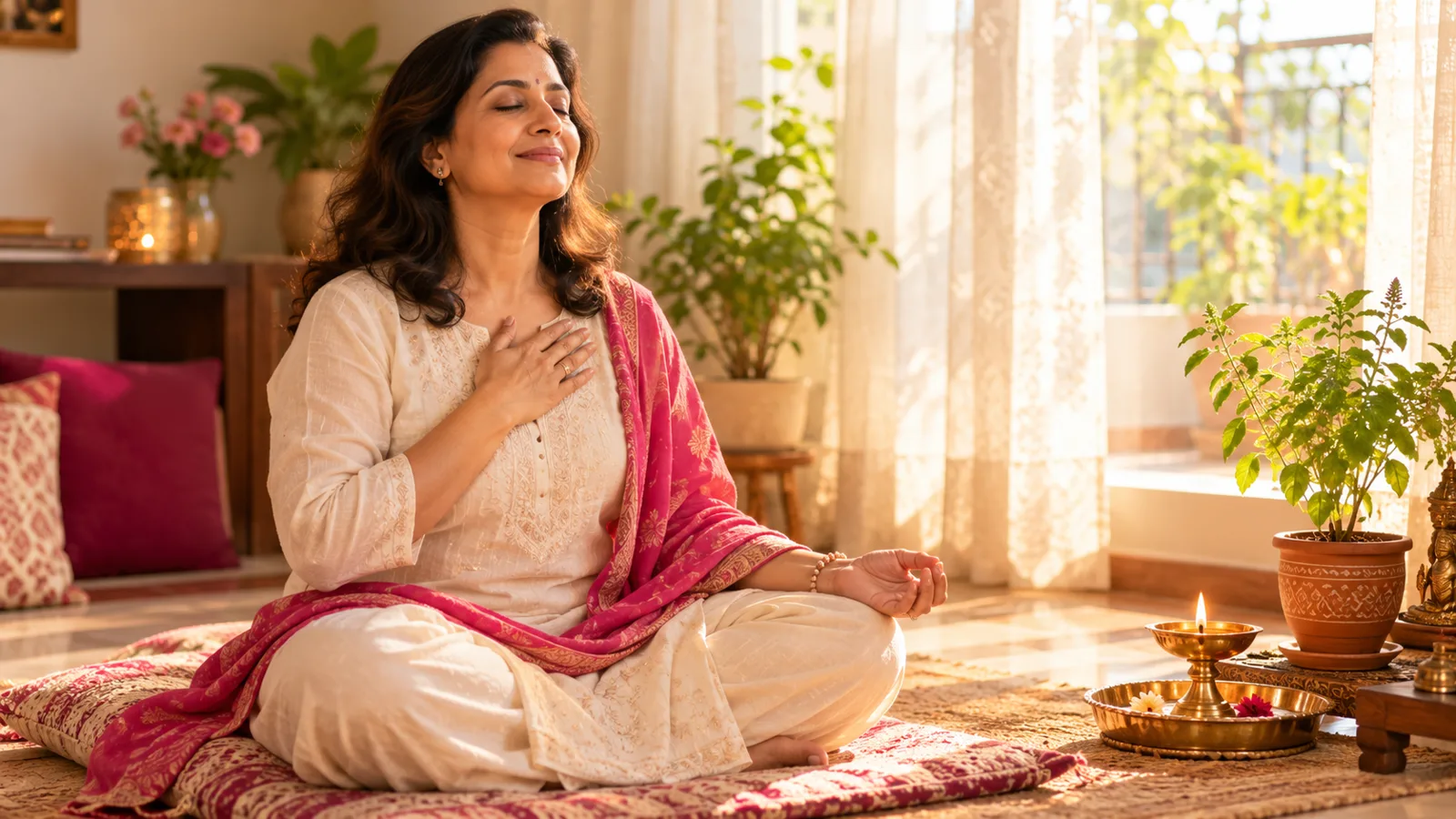
- Heart (about 40 seconds). Place a hand on your chest. Silently say: "I give and receive love."
- Throat (about 40 seconds). Bring attention to your throat. Silently say: "My voice matters."
- Third eye (about 40 seconds). Bring attention between your eyebrows. Silently say: "I see clearly."
- Crown (about 40 seconds). Bring attention to the top of your head. Silently say: "I am connected and at peace."
- Close (1 minute). Take three slow breaths. Notice which centre felt easy and which felt heavy. Open your eyes slowly.
Optional: at each centre you may softly hum its traditional seed sound (Lam, Vam, Ram, Yam, Ham, Om, and silence at the crown). Keep it soft and slow. There is no need for fast breathing or breath-holding in this practice.
Don't judge what you feel. A heavy centre is simply where your healing wants to begin.
Small daily habits for your Energy Centres
You don't need hours. Try one of these today:
- Morning: place your feet on the floor and say "I am safe" three times before you check your phone.
- During work: take five slow breaths before a difficult call.
- Evening: put a hand on your heart and name one thing you are grateful for.
- Before sleep: notice which Energy Centre felt tight today, and send it one kind breath.
Imagine a first-job professional in Mumbai who does just the 7-minute practice on her metro ride home. After two weeks, she may not feel magically different, but she might notice that she reacts a little more slowly and sleeps a little more easily. That is how real change usually feels: small and steady.

What changes when you start
Chakra healing will not remove every problem from your life. But many people find that with regular practice they:
- notice their feelings sooner, before they explode;
- feel more grounded when money or work worries come;
- speak up a little more easily;
- feel more connected to themselves.
There is no guarantee and no fixed timeline. The point is not perfection. It is returning, again and again, to yourself.
If you'd like to go deeper into letting go, try my 5-minute Ho'oponopono practice. If worry about money is heavy for you right now, read about the 5 hidden beliefs that keep money away, a natural partner to Root healing. And if you are always tired, my post on working hard but losing your health may help.
References
- Goyal M, Singh S, Sibinga EMS, et al. (2014). Meditation programs for psychological stress and well-being: a systematic review and meta-analysis. JAMA Internal Medicine. https://doi.org/10.1001/jamainternmed.2013.13018
- Zaccaro A, Piarulli A, Laurino M, et al. (2018). How breath-control can change your life: a systematic review on psycho-physiological correlates of slow breathing. Frontiers in Human Neuroscience, 12. https://doi.org/10.3389/fnhum.2018.00353
- Kalyani BG, Venkatasubramanian G, Arasappa R, et al. (2011). Neurohemodynamic correlates of 'OM' chanting: a pilot functional magnetic resonance imaging study. International Journal of Yoga, 4(1), 3-6. https://doi.org/10.4103/0973-6131.78171
- National Center for Complementary and Integrative Health. Meditation and mindfulness: effectiveness and safety. https://www.nccih.nih.gov/health/meditation-and-mindfulness-effectiveness-and-safety
- Purnananda. Shat-Chakra-Nirupana (16th century), in Arthur Avalon (Sir John Woodroffe), The Serpent Power (1919).
- Patanjali. Yoga Sutras, 3.29.
This article is for general wellness and education only. Energy Centre (chakra) healing is a spiritual and traditional practice, not a medical treatment, and it does not replace medical or psychological care. If you have a health condition, are pregnant, or feel overwhelmed, please speak to a doctor or counsellor; in India you can call Tele-MANAS on 14416. Read the full Medical & Wellness Disclaimer.
Frequently asked questions
What are the 7 chakras in simple words?
They are 7 Energy Centres along the spine: Root (safety), Sacral (emotions and joy), Solar plexus (confidence), Heart (love), Throat (expression), Third eye (intuition) and Crown (peace and connection).
Are chakras real or scientifically proven?
Chakras are a spiritual idea from Indian tradition. Science has not shown that they exist as physical structures. However, practices used in chakra healing, such as meditation and slow breathing, have research showing benefits for stress and anxiety.
How do I know which chakra is blocked?
There is no medical test. Notice your patterns: money worry often points to the Root, people-pleasing to the Solar plexus, holding grudges to the Heart, and swallowing your words to the Throat.
How long does chakra healing take?
There is no fixed time. Many people notice small shifts, like calmer reactions, within a few weeks of regular practice. Deeper patterns take longer, and that is normal.
Can beginners do chakra meditation at home?
Yes. A gentle practice like the 7-minute meditation above is suitable for most beginners. Keep it slow, avoid forceful breathing, and stop if you feel uncomfortable.
Is chakra healing linked to any religion?
It comes from Indian yoga and tantra traditions, but you do not need to follow any religion to practise it. It is open to people of every faith, or none.
Start today
Tonight, before you sleep, place one hand on your heart and one on your belly. Take five slow breaths and say, "I am safe. I am enough." That is your first step into chakra healing.
Did this post help you? Share your thoughts, ask me a question or connect with me on WhatsApp.
This post is for education and emotional wellbeing. It is not medical advice. Read the Medical & Wellness Disclaimer.