 Practices
EFT Tapping for Anxiety: A Simple 5-Minute Guide

EFT tapping is a simple way to calm anxiety by gently tapping on points on your face and body while naming what you feel. Here is what it is, what research honestly says, and a 5-minute routine to try today.
Does EFT tapping help with anxiety? EFT (Emotional Freedom Techniques) tapping means gently tapping on points of the face and upper body while you name what you feel. Several studies, including controlled trials, show it can lower anxiety and stress for many people. It is a simple self-help tool that supports, but does not replace, medical care.
Your heart starts racing before a meeting. Your stomach tightens when the phone rings. Your mind keeps saying, "What if something goes wrong?" You know you are safe, but your body doesn't seem to believe it.
If you have been searching for EFT tapping for anxiety, this post explains what it is, what research honestly says, and a simple 5-minute routine you can do anywhere, even in an office washroom.
What is EFT tapping?
EFT stands for Emotional Freedom Techniques. It is a self-help method where you gently tap with your fingertips on certain points of the face and upper body while you name what you are feeling.
It brings together three things:
- Focusing on the feeling, instead of running away from it.
- Kind, accepting words, such as "Even though I feel anxious, I deeply accept myself."
- Gentle tapping on acupressure points, the same kinds of points used in Chinese acupressure.
It is simple, needs no equipment and takes only a few minutes. Many people use it before exams, interviews, difficult conversations or when they can't sleep.
Your inner smoke alarm
Think of anxiety like a smoke alarm in your kitchen. Its job is to protect you. But sometimes it goes off when you just burn a piece of toast. The alarm is loud, your heart races, and everyone panics, even though there is no fire.
Your nervous system works the same way. It sometimes rings the alarm for a meeting, a message or a memory, as if your life were in danger. Tapping is like gently pressing the "hush" button and telling the body, "I see you. There is no fire right now."
Why tapping feels so natural
Think of how mothers in India put a crying baby to sleep. They hold the child close and give soft, rhythmic pats on the back, the thapki, often while humming. The baby doesn't understand words, but the body understands rhythm and touch. Slowly, the crying stops.
EFT works in a similar spirit. You become the calm parent to your own anxious body, with gentle rhythmic taps and kind words.
What modern research says
EFT has been studied more than many people realise, but the quality of research varies, so I'll share it honestly:
- Anxiety reduced in a meta-analysis. A review of 14 randomised trials with 658 people found a large drop in anxiety scores after EFT. Anxiety also dropped in the control groups, but much less (Clond, 2016). The author noted there was too little data to compare EFT with standard therapy like CBT.
- A newer review is more cautious. A 2025 systematic review of 7 randomised trials with 506 people found that EFT reduced anxiety compared with no treatment. It worked about as well as, or better than, breathing exercises and muscle relaxation, and about the same as CBT. But most studies had "some concerns" about bias, mainly because people rated their own anxiety and weren't blinded (Choi et al., 2025).
- Even one session helped stressed nurses. In a randomised trial in Turkey during the COVID-19 pandemic, 72 nurses caring for COVID patients were divided into two groups. Those who did one online group EFT session had lower stress, anxiety and burnout afterwards. The group without EFT didn't change (Dinçer & Inangil, 2021).
- How it works is still debated. Researchers who support EFT say its key ingredients are facing the feeling, changing how you think about it, and acupressure (Church et al., 2022). Other scientists argue the benefit may come mostly from the focusing and calming parts, not the specific points. This question is not settled yet.
- Indian research is just beginning. A 2025 study in Dehradun tested EFT with 100 B.Sc. nursing students for stress and anxiety (Mohindra et al., 2025). It didn't randomly assign students to groups, so it can't prove much yet. We need bigger, well-designed studies in India.
So the honest summary is: EFT looks like a safe, promising self-help tool for everyday anxiety. It isn't a replacement for treatment when anxiety is severe.

What ancient wisdom says
Indian healing has long known that some points on the body are special. The Sushruta Samhita, the ancient Indian text of surgery, describes 107 marma points (Sharira Sthana, chapter 6). These are vital meeting points of muscles, vessels, joints and life energy. Gentle work on marma points is still part of Ayurveda today. EFT points come from a different tradition, but the idea is similar: the body has gateways where touch can bring calm.
There is also a beautiful story in the Valmiki Ramayana that shows what anxiety does to us. At the end of the Kishkindha Kanda, the vanara army reaches the ocean shore. Lanka lies far across the water, and no one believes they can cross. Even Hanuman, the strongest of all, sits quietly, unsure of himself. Then the wise elder Jambavan comes to him and gently reminds him who he really is, his strength, his birth and his gifts. As Hanuman listens, his body begins to grow, his fear falls away, and he makes the great leap across the ocean.
Anxiety often makes us forget our own strength. In EFT, you become your own Jambavan. Each round of tapping says, "Even though I feel afraid, I accept myself, and I remember who I am."
This wisdom comes from Indian traditions and is open to people of every faith, or none.
A simple 5-minute EFT tapping routine
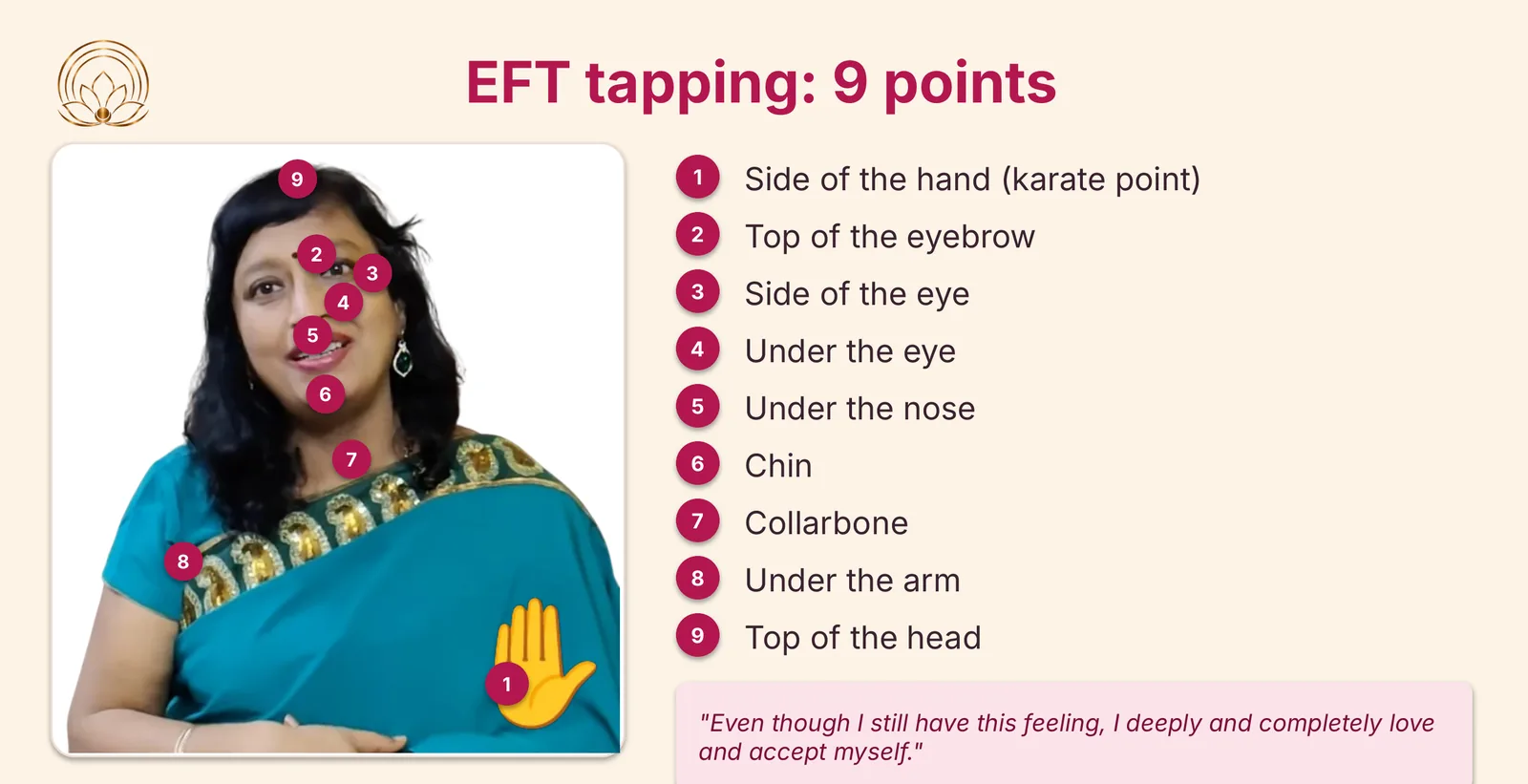
This is the one practice for this post. Use two or three fingertips and tap gently, about 5 to 7 times on each point. Tapping should feel soothing, never painful. You can tap on either side of the body.
Step 1: Name it and rate it (30 seconds). What are you anxious about? Say it in simple words, for example, "this tightness in my chest about tomorrow's meeting". Rate how strong it feels from 0 to 10.
Step 2: The setup (1 minute). Tap on the side of your hand (the fleshy edge below the little finger, where you would do a karate chop). Say three times: "Even though I feel this anxiety about tomorrow's meeting, I deeply and completely accept myself." If "deeply accept myself" feels too big, say, "I'm okay," or "I'm learning to accept myself."
Step 3: The tapping round (2 minutes). Tap each point while saying a short reminder phrase, such as "this anxiety" or "this tightness in my chest":
- Eyebrow: where the eyebrow begins, near the nose.
- Side of the eye: on the bone at the outer corner of the eye.
- Under the eye: on the bone below the centre of the eye.
- Under the nose: between the nose and upper lip.
- Chin: in the dip between the lower lip and chin.
- Collarbone: just below where the collarbones meet, about 2-3 cm to the side.
- Under the arm: on the side of the body, about a hand's width below the armpit.
- Top of the head: the crown.
Step 4: Breathe and rate again (30 seconds). Take one slow, deep breath. Rate your anxiety again from 0 to 10.
Step 5: Repeat if needed (1 minute). If it is still above 3, do another round with: "Even though I still have some of this anxiety, I accept myself." Many people feel a shift after 2 or 3 rounds.
To finish, you can tap a final round with a calm, positive phrase, such as "I am safe right now" or "I can handle this one step at a time".
Safety notes
- EFT is a self-help tool for everyday anxiety and stress. It isn't a treatment for anxiety disorders, panic disorder or trauma on its own.
- If you have strong memories of trauma, it is wiser to do tapping with a trained professional than alone.
- If tapping brings up strong distress, stop, breathe slowly, and ground yourself by looking at five things around you.
- If anxiety lasts for weeks, affects your sleep, work or relationships, or comes with chest pain or breathlessness, please see a doctor.
Common mistakes when tapping
- Being too vague. "I feel bad" works less well than "this knot in my stomach about my mother's call". Be specific.
- Skipping the rating. Rating before and after helps you notice small changes, which builds trust.
- Tapping too hard. It should feel like a gentle drumbeat, not a punch.
- Only saying positive words. Name the real feeling first. Calm words come at the end, once your body has been heard.
- Expecting magic in one round. Old anxieties may need several rounds over several days.
If anxiety keeps you awake at night, my post on how to stop overthinking at night can help. For a gentle healing practice of forgiveness, you may also like the 5-minute Ho'oponopono practice.

What changes when you tap regularly
People who tap regularly often notice that:
- they catch anxiety earlier, before it becomes overwhelming;
- their body calms down faster after a stressful moment;
- they feel more in control, because they have a tool in their own hands;
- they become kinder to themselves when they feel afraid.
There is no fixed timeline, and results differ from person to person. But each round is a small message to your body: "I'm here, and you are safe."
References
- Clond M (2016). Emotional Freedom Techniques for anxiety: a systematic review with meta-analysis. The Journal of Nervous and Mental Disease, 204(5), 388-395. View study
- Choi SH, et al. (2025). Emotional Freedom Techniques for anxiety disorders: a systematic review. Healthcare. View study
- Dinçer B, Inangil D (2021). The effect of Emotional Freedom Techniques on nurses' stress, anxiety, and burnout levels during the COVID-19 pandemic: a randomized controlled trial. Explore. View study
- Church D, Stapleton P, Vasudevan A, O'Keefe T (2022). Clinical EFT as an evidence-based practice for the treatment of psychological and physiological conditions: a systematic review. Frontiers in Psychology, 13, 951451. View study
- Mohindra A, et al. (2025). The role of Emotional Freedom Technique in reducing stress and anxiety among B.Sc. nursing students: findings from a quasi-experimental study. International Journal of Advanced Research. View study
- Sushruta Samhita, Sharira Sthana, chapter 6.
- Valmiki Ramayana, Kishkindha Kanda (end).
This article is for general wellness and education only. It is not medical or psychological advice, and EFT is not a treatment for anxiety disorders, panic attacks or trauma. If you live with trauma, please practise tapping only with a trained professional. If you have chest pain or breathlessness, please see a doctor first. If anxiety lasts for weeks or affects your daily life, please speak to a doctor or mental health professional; in India you can call Tele-MANAS on 14416. Read the full Medical & Wellness Disclaimer.
Frequently asked questions
What is EFT tapping?
EFT (Emotional Freedom Techniques) is a self-help method where you tap gently with your fingertips on acupressure points on the face and upper body while naming what you feel and accepting yourself.
Does EFT tapping really work for anxiety?
Several randomised trials and meta-analyses found that EFT reduced anxiety, often more than no treatment, and similar to breathing and relaxation methods. Many studies have quality limitations, so it is best seen as a promising self-help tool, not a cure.
What are the EFT tapping points?
The main points are the side of the hand, eyebrow, side of the eye, under the eye, under the nose, chin, collarbone, under the arm and top of the head.
How long does EFT tapping take to work?
Many people feel some relief after one to three rounds, which takes about 5 minutes. Long-standing anxiety may need regular practice over days or weeks.
Is EFT tapping safe?
It is generally safe and gentle for most people. If you have severe anxiety, panic attacks or trauma, use it with guidance from a trained professional, and keep seeing your doctor.
Start today
Think of one thing that is worrying you right now. Rate it from 0 to 10. Tap the side of your hand and say, "Even though I feel this worry, I accept myself." Then tap through the 8 points once, breathe, and rate again. That is your first round.
Did this post help you? Share your thoughts, ask me a question or connect with me on WhatsApp.
Want clarity on your own block? Book a free 1:1 Clarity Call.
This post is for education and emotional wellbeing. It is not medical advice. Read the Medical & Wellness Disclaimer.