 Practices
Root Chakra: How to Feel Safe With Money and Life
Some people worry about money even when their bank balance is fine. Here is what the Root Energy Centre means, what research says about money worry and the mind, and a simple 8-minute grounding practice to feel safe again.
Do you check your bank balance again and again, even when nothing has changed? Do you feel a knot in your stomach every time an unexpected bill arrives, even a small one? Maybe you earn well, yet a quiet voice keeps saying, "What if it all goes away?"
In the language of Indian yoga, this feeling of not being safe is linked with the root chakra, the first Energy Centre, at the base of the spine. In this post, you will learn what the Root Energy Centre is, why money worry can stay even when there is enough, what research and ancient wisdom say, and one simple 8-minute grounding practice to help you feel safe again.
What is the Root chakra?
The Root chakra, called Muladhara in Sanskrit, is the first of the seven Energy Centres, at the base of the spine. Mula means "root" and adhara means "support" or "base". In modern teaching, it is linked with safety, money, home, the body and feeling grounded on the earth.
If you are new to Energy Centres, my post on chakra healing for beginners explains all seven in simple words.
Think of a tree. When its roots are deep, it bends in a storm but does not fall. When its roots are shallow, even an ordinary wind shakes it. Many of us are not short of money as much as we are short of roots. Our life is fine, but we don't feel held.
An Energy Centre is a spiritual idea, not a body organ. It is a way to understand how safety, feelings and the body work together.
Signs your Root may need care
Ask yourself gently:
- Do you worry about money even when your bills are paid?
- Do you find it hard to spend on yourself, even on small needs?
- Do you feel restless, as if you can never fully relax at home?
- Do you keep changing jobs, cities or plans, but never feel settled?
- Do you hold on tightly to things, people or savings out of fear?
- Do you often feel tired, heavy in the legs, or disconnected from your body?
- Does a small change in plans make you feel that everything is falling apart?
If you said yes to three or more, your Root may be asking for care. These are invitations, not diagnoses.
Imagine a young software engineer in Pune. She has a good salary and some savings. Yet every month-end she feels a cold panic, as if one mistake could throw her onto the street. Her numbers say "safe". Her body says "danger". This gap is exactly what Root work is about.
Why money worry stays even when there is enough
Money worry is often like driving with the fuel light on. Even if the car can still go 50 km, your eyes keep going back to that little orange light. You can't enjoy the road. Your whole attention is pulled to one fear.
For many of us, that light was switched on long ago. Perhaps we grew up hearing, "We can't afford it," or saw elders fight about money. Perhaps there was a real loss: a business that failed, a job that ended, a move to a new city. The body remembers that feeling of the ground shaking, and keeps the alarm on long after the danger has passed.
This is why more money alone does not always bring peace. If the alarm lives inside, a bigger salary only gives it a bigger number to worry about. I have written more about these early beliefs in my post on the hidden beliefs behind money blocks.
What modern research says
Science does not measure chakras. But it has studied money worry, the mind and calming practices carefully. Here is what it says:
- Money stress and low mood go together. A systematic review of 40 studies found that financial stress was linked with depression in both richer and poorer countries, and the link was stronger in people with lower income or wealth (Guan et al., 2022). Most studies were observational, so they show a link, not cause and effect.
- Money worry takes up mental space. An Indian study showed it. Researchers tested 464 sugarcane farmers in India before and after harvest. The same farmers scored better on thinking tests after the harvest, when money had come in, than before it, when money was tight (Mani et al., 2013). The authors suggest that money worries use up attention, leaving less for everything else.
- The effect is real, but smaller than first thought. A later meta-analysis combined data from more than 111,000 people. It found that money scarcity does lower thinking performance, but much of the effect was explained by education, leaving a small direct effect (de Almeida et al., 2024). This is an honest reminder that research is still growing.
- Slow breathing calms the body. A review of 15 studies in healthy people found that breathing slowly, under about 10 breaths a minute, was linked with more relaxation and less anxiety and anger (Zaccaro et al., 2018).
- Yoga can ease anxiety. A meta-analysis of 8 randomised trials found that yoga had a small short-term effect in reducing anxiety in people with high anxiety levels, and seemed safe. The evidence for diagnosed anxiety disorders was not clear (Cramer et al., 2018).
So research cannot prove a Root chakra. But it does show that money worry weighs on the mind, and that simple body-based practices like slow breathing and yoga can help us feel calmer. That is exactly what Root work uses.

What ancient wisdom says
In the old text Shat-Chakra-Nirupana (16th century), the Muladhara is described as a red lotus of four petals at the base of the spine. Inside it is a square, the region of the earth element, and its seed sound is Lam (Arthur Avalon's translation, The Serpent Power, 1919). Earth is what holds us up. The symbol says it simply: the first step of the inner journey is to feel supported.
The Bhagavad Gita speaks about safety in one of its most loved verses:
Ananyāś chintayanto māṁ ye janāḥ paryupāsate, teṣhāṁ nityābhiyuktānāṁ yoga-kṣhemaṁ vahāmy aham. (Bhagavad Gita 9.22)
My simple meaning: for those who think of Me with steady devotion, I bring what they lack and protect what they already have. (Checked against standard English translations.)
Yoga-kshema, gaining what we need and keeping what we have, is the very worry of the Root. You may have seen these words before without noticing: "Yogakshemam Vahamyaham" is the motto of LIC, the Life Insurance Corporation of India. A promise of safety, taken straight from the Gita.
There is also a well-loved story in the Bhagavata Purana (Canto 10, chapters 80-81). A poor brahmin, remembered as Sudama, was Krishna's childhood friend. His wife urged him to visit Krishna in Dwarka. All he could carry as a gift was a handful of flattened rice tied in a cloth. Krishna welcomed him with great love and ate the rice with joy. Sudama felt too shy to ask for anything, and returned home with empty hands. But when he reached home, he found it transformed.
I don't read this as a promise that prayer brings riches. I read it this way: Sudama felt rich in love before anything changed outside. His peace did not wait for his bank balance. That is the heart of a healthy Root.
This wisdom comes from Indian traditions and is open to people of every faith, or none.
An 8-minute Root grounding practice
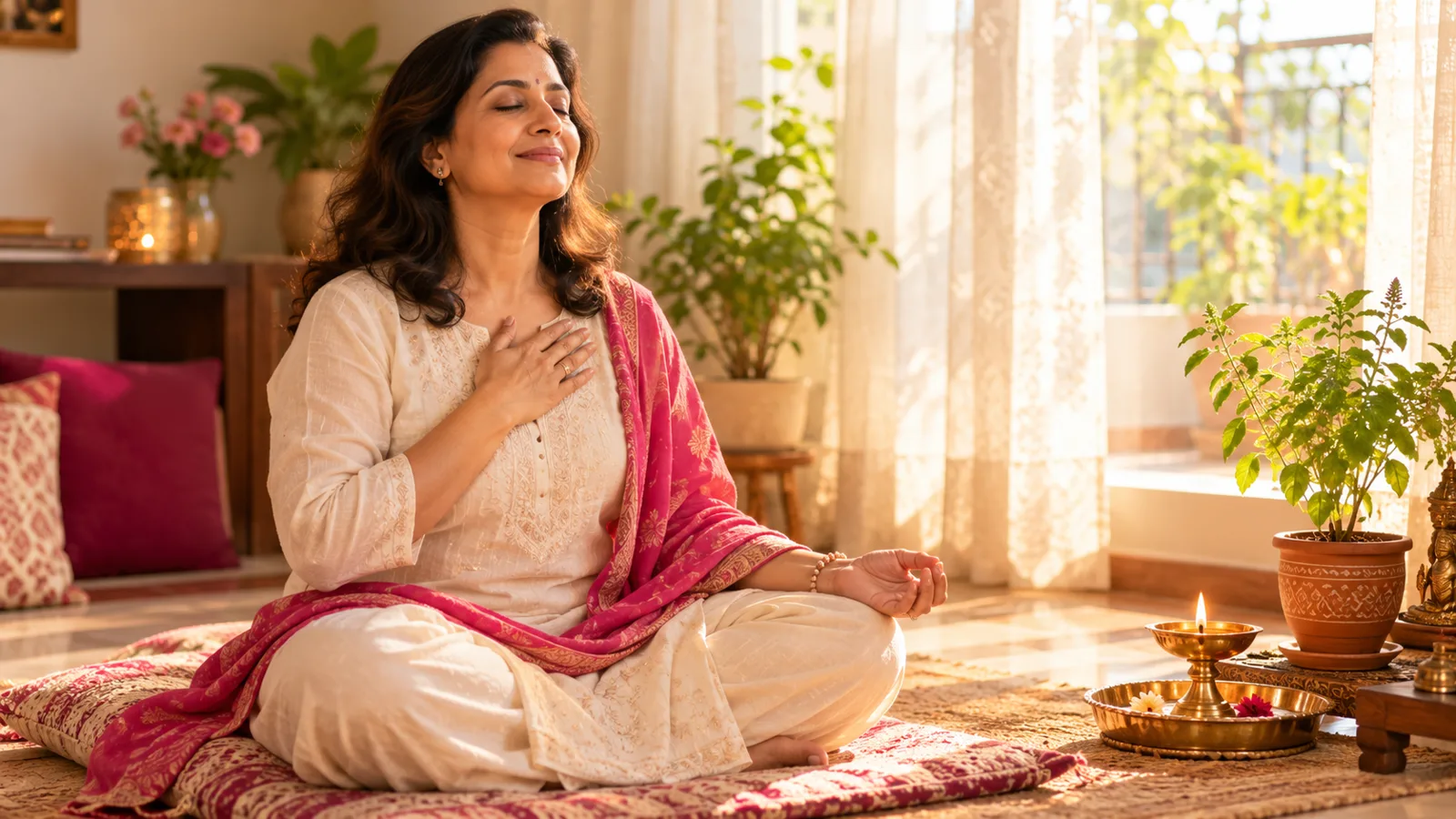
This is the one practice for this post. Do it in the morning, or any time money worry rises. You can do it standing on the floor, or barefoot on grass if you can.
- Stand and feel your feet (1 minute). Stand with your feet hip-width apart, knees soft, arms relaxed. Press your feet gently into the ground. Notice your heels, the balls of your feet, your toes. Say silently, "The earth is holding me."
- Breathe slowly (3 minutes). Breathe in through your nose for a count of 4. Breathe out slowly for a count of 6. Imagine your breath travelling down your legs into the earth, like roots growing.
- Hum softly (2 minutes). Sit down if you like. On each out-breath, hum the sound "Lam" gently, feeling a soft vibration at the base of your spine. If "Lam" feels strange, a simple "mmm" hum works too.
- Name three safe things (1 minute). Open your eyes. Say or write three things that are safe right now: "I have a roof over my head. I had food today. I have someone I can call."
- Take one small step (1 minute). Choose one small, practical money step for today: check one bill, save a small amount, or write down this week's expenses. Calm first, then action.
If you feel dizzy, breathe normally and sit down. If you are pregnant, have a heart condition or are under treatment for anxiety, keep the breathing gentle and natural.
Small daily habits for a strong Root
- Walk barefoot on grass or soil for a few minutes when you can.
- Keep a simple routine for waking, meals and sleep. Routine tells the body it is safe.
- Eat warm, home-cooked food at regular times.
- Know your numbers. Fear grows in the dark. Writing down what comes in and goes out each month often brings more calm than avoiding it.
- Declutter one small space. A tidy drawer can feel surprisingly steadying.
- Say thank you for what you have. Gratitude for today's roof and food tells the mind that the ground is still there.

What changes when your Root feels safe
Healing the Root doesn't mean money problems vanish. Real-world steps, like a budget, savings and good advice, still matter. But many people find that, over weeks of steady practice:
- they think more clearly about money, instead of freezing or avoiding it;
- they sleep better, with fewer "what if" thoughts;
- they can spend on real needs without guilt, and save without fear;
- they feel more at home in their own body and their own life.
Healing happens layer by layer. Some days the old alarm will ring again. That is normal. Each time, come back to your feet and your breath.
References
- Guan N, Guariglia A, Moore P, Xu F, Al-Janabi H (2022). Financial stress and depression in adults: a systematic review. PLOS ONE, 17(2), e0264041. View study
- Mani A, Mullainathan S, Shafir E, Zhao J (2013). Poverty impedes cognitive function. Science, 341(6149), 976-980. View study
- de Almeida F, Scott IJ, Soro JC, et al. (2024). Financial scarcity and cognitive performance: a meta-analysis. Journal of Economic Psychology, 101, 102702. View study
- Zaccaro A, Piarulli A, Laurino M, et al. (2018). How breath-control can change your life: a systematic review on psycho-physiological correlates of slow breathing. Frontiers in Human Neuroscience, 12, 353. View study
- Cramer H, Lauche R, Anheyer D, et al. (2018). Yoga for anxiety: a systematic review and meta-analysis of randomized controlled trials. Depression and Anxiety, 35(9), 830-843. View study
- Avalon A (1919). The Serpent Power, translation of the Shat-Chakra-Nirupana.
- Bhagavad Gita 9.22.
- Bhagavata Purana, Canto 10, chapters 80-81.
This article is for general wellness and education only. It is not medical advice. It is not financial advice. If money worry or low mood lasts for weeks or affects your daily life, please speak to a doctor or mental health professional, and for money decisions, a qualified financial adviser; in India you can call Tele-MANAS on 14416. Read the full Medical & Wellness Disclaimer.
Frequently asked questions
What is the root chakra?
The root chakra, or Muladhara, is the first of the seven Energy Centres described in Indian yoga, at the base of the spine. In modern teaching, it is linked with safety, money, home and feeling grounded.
What are the signs of a blocked root chakra?
Common signs people describe include constant money worry even when there is enough, restlessness, feeling unsettled at home, fear of change and feeling disconnected from the body. These are invitations to care for yourself, not medical diagnoses.
How do I heal my root chakra?
Gentle grounding helps most: standing with your feet on the earth, slow breathing, soft humming of the sound "Lam", a steady daily routine, and small practical steps with money. Practise a few minutes daily.
Is the root chakra connected to money?
In modern Energy Centre teaching, yes: the Root is linked with safety and survival, which includes money. Research also shows that money worry takes up mental space, so calming the body can help you think more clearly about money.
Why do I always worry about money, even when I have enough?
Often the worry comes from old experiences, such as growing up with money stress or a past loss. The body keeps the alarm on even after things improve. Grounding practices and looking clearly at your numbers can slowly calm it.
Start today
Before bed tonight, stand barefoot for one minute. Feel your feet on the floor, breathe out slowly three times, and say, "The earth is holding me. I am safe right now." Then name one thing you are grateful for. That is your first root.
Did this post help you? Share your thoughts, ask me a question or connect with me on WhatsApp.
This post is for education and emotional wellbeing. It is not medical advice. Read the Medical & Wellness Disclaimer.